What Are the Top 10 Types of Stamped Contact Springs?
Choosing the right Stamped Contact Spring begins with more than appearance. It requires practical knowledge of force, travel, contact pressure, material behavior, and production limits. In a connector, a spring may look like a tiny folded strip, yet its performance depends on every bend radius and contact point. A poorly controlled curve can cause weak retention, unstable conductivity, or early fatigue.
This guide examines ten common types, including cantilever, U-shaped, leaf, beam, dome, wave, torsion, compression, grounding, and multi-contact designs. Classifications can overlap. That is one limitation worth admitting. Manufacturers may name the same geometry differently, depending on its function or forming method. The useful question is not only, “What is this spring called?” It is also, “How does it behave inside the assembly?”
Spring engineering pioneer Robert Hooke offered a lasting principle: “Ut tensio, sic vis,” meaning “As the extension, so the force.” He was not a modern stamped-contact specialist, but the idea still guides material selection and deflection control. Engineers today apply it alongside fatigue testing, plating evaluation, dimensional inspection, and real-world insertion-cycle testing.
Small details matter. A 0.05-millimeter variation may alter contact force. A sharp edge may damage plating. A slightly incorrect bend may shift the electrical path. The following overview connects each Stamped Contact Spring type with its structure, typical use, advantages, and practical limitations. Some designs appear simple. They are not always easy to optimize.
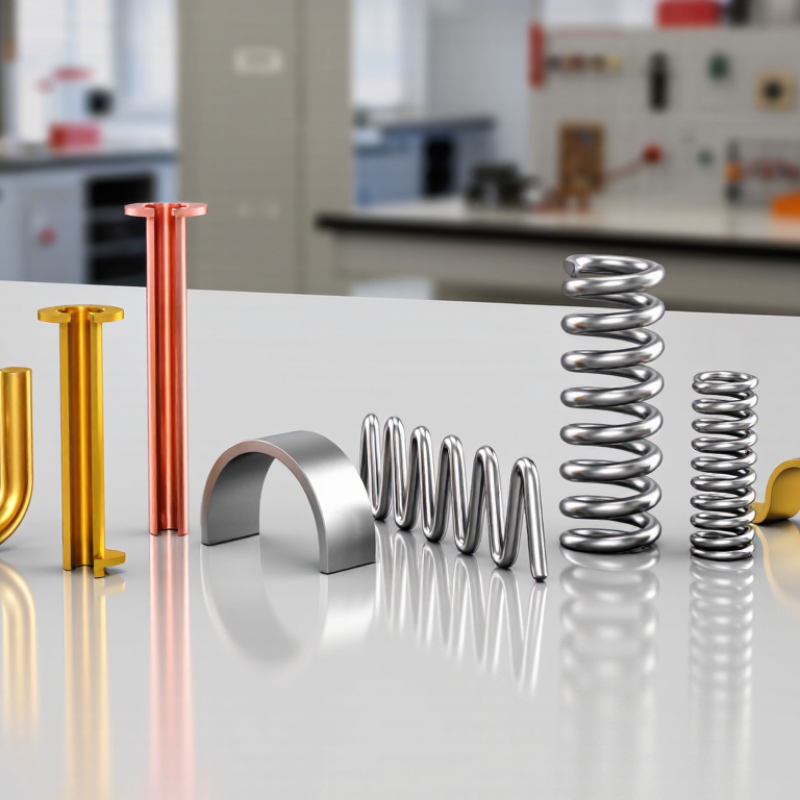
Definition and Function of Stamped Contact Springs
What Are the Top 10 Types of Stamped Contact Springs?
Stamped contact springs are elastic metal parts formed from thin sheet material. They provide controlled pressure between conductive surfaces. This pressure supports stable electrical contact during vibration, movement, and repeated assembly.
Common forms include cantilever, leaf, dome, U-shaped, V-shaped, wave, torsion, compression, battery, and grounding springs. Each shape manages force differently. A cantilever spring bends from one fixed end. A dome spring provides short travel and noticeable tactile feedback. Wave and compression designs suit limited spaces. Grounding springs help maintain contact with coated or uneven surfaces. The best choice depends on stroke, current, available space, and required service life.
Small details matter. A spring that feels firm may lose force after repeated cycling. A sharp edge can damage nearby insulation. Plating, material thickness, bend radius, and stamping direction all influence performance. Engineers commonly inspect contact resistance, spring force, permanent deformation, and fatigue behavior. Practical testing should include temperature changes and vibration, not only room-temperature measurements. In practice, no design is perfect. A calculation may look correct, yet assembly variation can create weak contact. That is why prototype testing and production feedback remain essential.
What Are the Top 10 Types of Stamped Contact Springs?
Stamped contact springs are thin metal components formed by cutting and bending sheet material. They provide controlled contact force, electrical continuity, wiping action, retention, grounding, or switching in compact assemblies.
The chart compares ten widely used stamped-contact spring geometries by their typical functional roles. A value of 1 indicates that the function is commonly associated with the geometry; a value of 0 indicates that it is not usually the primary design purpose. Actual performance depends on material, thickness, heat treatment, geometry, and assembly conditions.
The Top 10 Types of Stamped Contact Springs
The Top 10 Types of Stamped Contact Springs
Stamped contact springs support reliable electrical contact in connectors, switches, battery systems, and compact control modules. Grand View Research reported that the global electrical connectors market was valued at about USD 78 billion in 2023. This growth increases demand for smaller, repeatable spring contacts.
The leading types include cantilever-beam, dual-beam, four-point, box-beam, tulip, fork, crown, torsion, compression, and U-shaped stamped contact springs. Cantilever beams suit compact layouts and moderate insertion forces. Dual-beam designs offer a useful backup path when one contact point weakens. Four-point contacts improve stability, especially under vibration. Box-beam springs resist twisting during mating. Tulip and crown styles guide round pins with multiple contact points. Fork springs provide open access for flat terminals. Torsion springs deliver rotational wiping action. Compression springs maintain force along a straight axis. U-shaped designs are simple, flexible, and economical.
Real-world selection requires more than counting contact points. IEC 60512 testing evaluates mating force, electrical resistance, temperature rise, and mechanical endurance. A 2024 connector industry report from MarketsandMarkets also identifies miniaturization and higher current density as major design drivers. Thin stainless steel may save space, yet it can lose contact force after repeated deflection. That matters.
Manufacturing teams should check plating thickness, burr control, springback, and fatigue performance. A design that looks ideal in CAD may fail after dust, heat, or vibration exposure. Testing remains essential. Contact geometry is only part of the answer.
Manufacturing Methods and Performance Characteristics
Stamped contact springs combine electrical continuity with controlled mechanical movement. The ten common forms include flat, cantilever, box, dome, crown, tulip, bifurcated, multi-beam, folded, and torsion-contact springs. Each shape changes force, travel, wiping action, and contact stability.
Progressive-die stamping supports high-volume production with repeatable pitch and feed control. Fine blanking can improve edge quality and reduce burr-related interference. Coining strengthens contact points and helps control electrical resistance.
Forming must account for spring-back, especially in stainless steel and phosphor bronze. Beryllium copper offers strong fatigue performance, but material handling requires careful process controls.
The IEA Global EV Outlook 2024 recorded nearly 14 million electric-car sales in 2023. This growth increases demand for compact, low-resistance contact systems. USGS Mineral Commodity Summaries 2024 reported about 22 million metric tons of mined copper production in 2023. Supply remains important.
Tips: Match the spring geometry to the required stroke, not only the available space. Verify normal force after plating and forming. ASTM B117 salt-spray results can help compare coatings, but they do not predict complete field life. A practical mistake is testing new parts only. Test worn, misaligned, and thermally cycled samples too. No design wins everywhere.
Selection Guidelines for Different Applications
What Are the Top 10 Types of Stamped Contact Springs?
Selection Guidelines for Different Applications
Stamped contact springs include flat, cantilever, beam, leaf, U-shaped, V-shaped, wave, coil, torsion, and multi-finger designs. Each geometry controls contact force, travel, retention, and electrical stability. Flat springs suit compact assemblies with limited movement. Cantilever and beam springs work well when controlled deflection is required. U-shaped and V-shaped forms provide useful preload. Wave and coil springs absorb greater movement, while torsion springs manage rotational loading. Multi-finger contacts can improve redundancy, but they may increase tooling complexity.
Selection should begin with contact force, stroke, current, temperature, and available space. For low-current signal paths, stable normal force and surface consistency matter most. Higher-current applications require careful attention to resistance, heat rise, and contact pressure. A 2024 Grand View Research report valued the global metal stamping market at over USD 220 billion, showing the scale of high-volume formed components. However, market size does not guarantee design quality.
Material choice remains critical. Copper alloys offer strong conductivity, while stainless alloys provide better spring recovery and corrosion resistance. Check stress levels against the material’s fatigue data. Use finite-element analysis before production, then verify force and resistance through cycle testing. ASTM B117 salt-spray testing can support corrosion evaluation, but it cannot represent every real environment. I have seen designs pass static checks and fail after repeated vibration. That is a useful warning. Do not select a spring by shape alone. Production tolerance, plating thickness, burr control, and assembly alignment can change performance significantly.