Top PVC Door Cutting Machines for Global Buyers
Global demand for efficient PVC door production is increasing as builders seek cleaner finishes, faster delivery, and lower material waste. Grand View Research’s PVC industry analysis identifies construction as a major demand driver, while MarketsandMarkets reports continuing investment in automated CNC equipment. These trends make the Pvc Door Cutting Machine an important purchasing decision for fabricators, distributors, and large project contractors.
Dr. David A. Dornfeld, a respected manufacturing researcher and author, offers a useful principle: “Manufacturing is a system, not a collection of isolated machines.” His observation applies directly to PVC door production. A cutting machine must match the profile shape, blade quality, extraction system, software, and operator skill. A fast spindle means little if the cut leaves melted edges or uneven corners. No machine is perfect.
This guide compares leading Pvc Door Cutting Machine options for global buyers. It considers cutting accuracy, repeatability, processing speed, dust control, maintenance access, and technical support. It also examines practical details, such as whether a 2.4-meter profile fits comfortably, whether the control panel supports multiple languages, and whether replacement blades are locally available. Reported specifications can be useful, but they are not the whole story. Some manufacturers publish ideal laboratory results. Real workshops face humidity, worn tooling, unstable power, and hurried operators. Buyers should test representative PVC profiles before committing to a purchase. That step may feel slow, yet it often prevents expensive production mistakes.
What a PVC Door Cutting Machine Is and How It Works
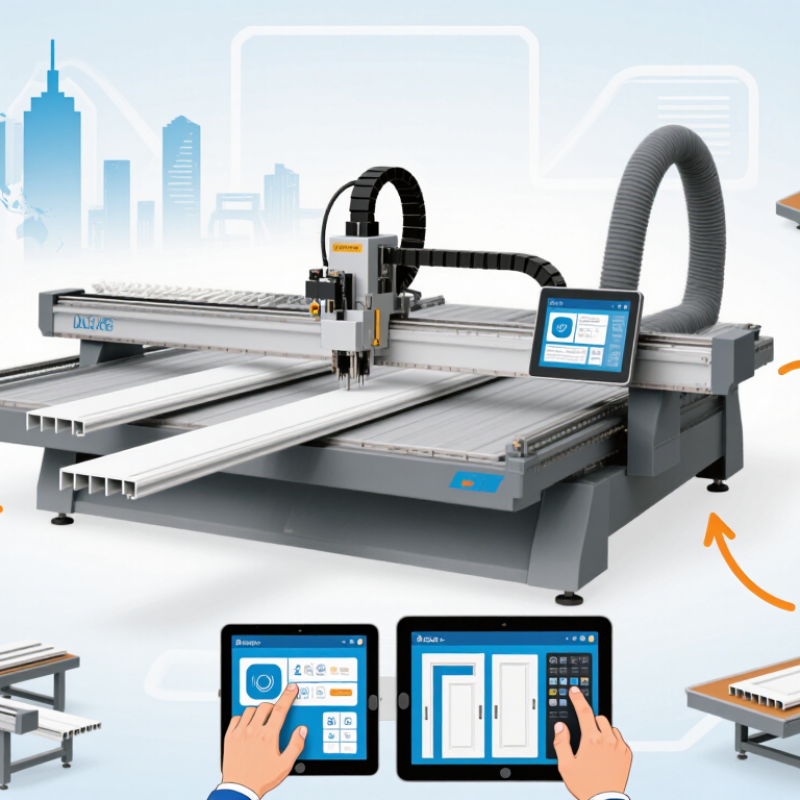
A PVC door cutting machine is industrial equipment designed to cut PVC panels, frames, or reinforced profiles to precise dimensions. It usually combines a measuring system, clamping table, cutting blade, and dust extraction unit. The operator enters the required length. The machine secures the material, moves the blade, and completes a straight or angled cut.
Some models use a circular saw, while CNC versions follow digital cutting paths. The workflow is simple but sensitive. A loose clamp can create vibration, rough edges, or inaccurate joints.
Grand View Research estimates that the global PVC market was worth about US$45 billion in 2023, with construction as its largest application. Its outlook also indicates near 4% annual growth through 2030.
This demand increases pressure on workshops to reduce material waste and repeatable cutting errors. Still, automation is not magic. Poor calibration remains a practical problem.
Tips:
Measure twice. Check blade sharpness daily. Keep the cutting table free of chips. Confirm voltage, guarding, and emergency-stop requirements before installation. The International Energy Agency reports that buildings account for roughly 30% of global energy demand, encouraging more efficient construction processes. A well-adjusted PVC cutting machine supports that goal by improving yield and reducing discarded profiles. However, operators should test each new material batch. PVC density, reinforcement, and surface finish can vary slightly. Clean cuts matter.
Key Machine Types for Different PVC Door Production Needs
Top PVC Door Cutting Machines for Global Buyers
Key Machine Types for Different PVC Door Production Needs
PVC door production rarely depends on one cutting machine. Small workshops often choose a single-head saw for custom orders and limited daily output. It needs accurate angle settings, a stable fence, and a clear measuring scale. Simple controls can reduce training time. They also limit automation.
Double-head saws suit factories making repeated frames. Two blades cut both ends in one cycle, improving length consistency. A servo-controlled model can store common profiles and angles. Operators should still check blade alignment each shift. Small errors become visible at the corners.
CNC routing and drilling centers support complex doors with locks, hinges, drainage paths, or decorative openings. They require reliable software, fixture control, and profile libraries. End milling machines prepare transoms and mullions with repeatable joints. Corner cleaning machines remove excess weld beads after assembly. This improves appearance and reduces hand finishing.
Machine choice should match profile size, order volume, floor space, and local power conditions. Buyers should request sample cuts before purchase. Ask for tolerance data, maintenance schedules, safety instructions, and operator training. Spare blades and compatible tooling also affect long-term costs. In practice, advertised speed can be misleading when setup time is ignored. A slower machine may produce fewer defects and require less rework. That trade-off deserves careful review.
Essential Features to Compare Before Choosing a Machine
Top PVC Door Cutting Machines for Global Buyers
Choosing a PVC door cutting machine requires more than comparing motor power. Cutting accuracy, stability, and daily usability matter more on a busy production floor. A rigid frame reduces vibration when the blade meets reinforced profiles. Look for adjustable cutting angles, clear measurement scales, and a controlled feeding system. A small error at the first cut can become a serious fitting problem later.
Blade quality deserves close attention. The machine should support clean cuts without excessive melting, chipping, or rough edges. Test several PVC profiles before purchasing, including thicker sections and reinforced frames. Dust extraction is also important. Fine PVC particles can spread across the workshop quickly. I have found that accessible blade guards and simple maintenance points save valuable time, although no machine removes every operating challenge.
Tips: Ask for sample cuts, noise readings, power requirements, and maintenance instructions. Check whether operators can adjust settings without special tools. Confirm local voltage compatibility and available technical support. Do not judge performance from one perfect demonstration. Run repeated cuts and inspect the final dimensions. A machine may look efficient during a short test, yet feel slow after eight hours of production. Leave room for honest review.
How to Evaluate Cutting Accuracy, Speed, and Automation
Top PVC Door Cutting Machines for Global Buyers
Choosing a PVC door cutting machine requires more than reading its maximum speed. Cutting accuracy affects frame alignment, sealing quality, and installation time. During testing, measure diagonal differences on several finished profiles. A reliable machine should produce repeatable results, not just one impressive sample. Even a 0.5-millimeter deviation can create visible gaps in a large door assembly.
Speed also needs practical evaluation. Ask for cycle times with real PVC profiles, including loading, clamping, cutting, and unloading. A fast blade is not always a fast machine. Watch for vibration, blade changes, and operator adjustments. These small delays often reduce daily output. Automation should simplify work, not hide problems. Check whether sensors detect profile length, clamping position, and cutting errors. Review the control interface, safety functions, and maintenance records before purchase.
Tips: Request test cuts using your own profile sizes. Compare ten pieces, not one. Record accuracy, cycle time, noise, and rejected parts. Check whether operators can correct settings without specialist support. Also examine software compatibility and remote service options. A complicated system may look advanced, yet become difficult during a busy production shift. My view is cautious: advertised precision can change with material temperature, blade wear, and operator habits. Allow a tolerance range in your evaluation, and document every test condition.
Safety, Maintenance, and Global Purchasing Considerations
PVC door cutting machines should be judged by safety details, not cutting speed alone. A guarded blade area, two-hand controls, and an emergency stop should be easy to reach. Operators need clear sight lines around the worktable. Dust extraction also matters, because fine PVC particles can settle on sensors and floors. A short trial cut can reveal vibration, rough edges, or unstable clamping.
Maintenance begins with a simple daily check. Remove chips from guides, inspect cables, and confirm that clamps hold the profile firmly. Blades should be checked for heat marks and uneven teeth. Lubrication intervals must follow the technical manual, not guesswork. I have seen small alignment errors create repeated waste. The machine still ran, but finished doors failed quality checks. That is an expensive warning.
Global buyers should request voltage, frequency, plug, language, and spare-part information before ordering. Confirm the packing method, moisture protection, installation support, and operator training. Ask for test videos using profiles similar to your own. Technical documents should include tolerances, maintenance schedules, and emergency procedures. A low purchase price can hide difficult freight handling or slow service. Compare total operating cost, not only the invoice. Even experienced buyers can miss a small detail. A written checklist reduces that risk.
| Machine Category | Typical Cutting Capability | Typical Technical Range | Safety and Compliance Priorities | Global Purchasing Checklist |
|---|---|---|---|---|
| Machine Selection and Production Data | ||||
| Single-Head PVC Profile Saw | Suitable for low- to medium-volume cutting of PVC door and window profiles, glazing beads, and reinforcement sections. | Blade diameter: 300–500 mm Cutting length: approximately 300–6,000 mm Cutting angles: usually 45° and 90° | Guarded blade enclosure, emergency stop, stable work support, adjustable clamps, and controlled restart after power interruption. | Confirm profile dimensions, available floor space, electrical voltage, spare-blade availability, operator training, and local conformity requirements. |
| Double-Head Mitre Saw | Designed for repetitive frame production where two profile ends must be cut accurately and consistently. | Two synchronized cutting heads Common cutting angles: 45° and 90° Typical positioning: manual, semi-automatic, or CNC-controlled | Interlocked head guards, pneumatic or mechanical clamping, anti-pinch protection, emergency stop circuits, and safe access to the cutting zone. | Ask for cutting-tolerance data, minimum and maximum frame sizes, positioning repeatability, software language options, and commissioning support. |
| Four-Head CNC Profile Cutting Centre | High-volume production of PVC door and window components with automated length positioning and recipe management. | Multi-axis positioning Automatic length measurement Suitable for integrated production lines | Full perimeter guarding, door interlocks, safety-rated control circuits, safe maintenance access, dust extraction provisions, and documented risk assessment. | Evaluate control-system compatibility, data backup, remote diagnostics, operator skill requirements, installation conditions, and availability of critical electronic parts. |
| V-Notching and End-Milling Unit | Processes selected PVC profile areas for joints, drainage paths, locks, handles, and hardware preparation rather than simple length cutting. | CNC or dedicated-tool operation Tooling depends on profile geometry Often integrated with drilling or routing stations | Guarded cutters, chip containment, secure profile clamping, tool-change isolation, and protection against accidental cycle initiation. | Provide sample profiles and drawings before purchase; verify tooling life, changeover time, programming method, and dust/chip extraction requirements. |
| Portable or Compact Profile Saw | Useful for installation work, repair operations, small workshops, and occasional on-site PVC profile cutting. | Compact footprint Manual feed Lower production capacity than fixed industrial equipment | Blade guard, non-slip support, secure transport position, two-handed controls where applicable, and protection from exposed electrical connections. | Check portability, power-source compatibility, replacement-blade dimensions, noise level, dust collection, and service access in the destination country. |
| Safety, Maintenance, and Operating Controls | ||||
| Daily Operator Inspection | Completed before each shift or production session. | Inspect guards, emergency stops, clamps, cables, air hoses, blade condition, work supports, and visible fasteners. | Do not operate the machine if a guard, emergency stop, clamp, or electrical protection device is defective. | Use a signed checklist with machine identification, inspection date, operator name, findings, and corrective action. |
| Blade and Tooling Maintenance | Cut quality depends on sharp, correctly specified tooling and proper feed conditions. | Replace or professionally sharpen blades when cut edges become rough, heat marks appear, vibration increases, or cutting force rises. | Isolate electrical and pneumatic energy before blade changes; use the correct tool, arbor size, rotation direction, and personal protective equipment. | Confirm local availability of blades, cutters, arbor accessories, sharpening services, and technical specifications in metric units. |
| Cleaning and Dust Control | Remove PVC chips and dust from the cutting area, guides, clamps, sensors, and ventilation paths. | Clean at the end of each shift or more frequently in high-output production; use suitable industrial extraction equipment. | Do not clean near moving tooling; stop and isolate the machine first. Avoid directing compressed air toward bearings, sensors, or control cabinets. | Verify extraction-port size, local ventilation rules, filter replacement requirements, and whether the installation needs a dedicated dust collector. |
| Lubrication and Mechanical Checks | Lubricate approved moving parts and inspect guides, bearings, belts, screws, clamps, and pneumatic components. | Follow the equipment manual because lubrication intervals vary by duty cycle, component type, environment, and manufacturer specification. | Use only specified lubricants and isolate the machine before reaching into guarded areas or adjusting mechanical components. | Request a preventive-maintenance schedule, lubricant specifications, wear-part list, and recommended service intervals before ordering. |
| Electrical and Pneumatic Maintenance | Reliable power and compressed air are essential for automated clamping, positioning, and cutting systems. | Check supply voltage and frequency, grounding, air pressure, air quality, filters, regulators, hoses, and leakage. | Electrical work should be performed by qualified personnel. Depressurize pneumatic circuits before servicing valves, cylinders, or hoses. | Confirm destination-country voltage, plug configuration, circuit protection, air-pressure requirements, compressor capacity, and documentation language. |
| Global Purchasing and Total-Cost Considerations | ||||
| Technical Specification Review | Compare machines using the same profile sizes, cutting angles, tolerance targets, production cycle, and material conditions. | Request a complete specification covering working range, blade data, motor rating, cycle time, positioning accuracy, machine dimensions, and net weight. | Check that safety functions are documented and that operating, maintenance, electrical, and pneumatic diagrams are supplied. | Ask for sample-cut results using the buyer's actual PVC profiles rather than relying only on catalogue figures. |
| Factory Acceptance Testing | Confirms machine performance before dispatch. | Test profile loading, clamping, cutting accuracy, repeatability, cycle operation, emergency stops, and fault recovery. | Record safety-test results and verify that protective devices cannot be easily bypassed during normal operation. | Use an agreed acceptance protocol with measurable pass/fail criteria, photographs, test pieces, and signed documentation. |
| Shipping and Installation | Machine size and weight influence packing, freight mode, unloading equipment, and installation cost. | Prepare foundation, floor loading, lifting access, power, compressed air, extraction, lighting, and working clearance in advance. | Use suitable lifting points and follow packing, transport, and installation instructions to prevent damage or unsafe assembly. | Clarify Incoterms, export packing, insurance, customs documents, import duties, unloading responsibility, and on-site installation scope. |
| Training and Documentation | Training should cover operation, setup, tooling changes, cleaning, troubleshooting, and emergency procedures. | Required documents normally include an operating manual, maintenance schedule, electrical drawings, pneumatic diagrams, parts list, and software backup where applicable. | Operators should be trained to stop the machine, isolate energy, report defects, and respond to abnormal noise, vibration, or material movement. | Confirm document language, online support availability, response times, spare-parts ordering process, and training format before final payment. |
| Total Cost of Ownership | Purchase price is only one part of the long-term operating cost. | Consider tooling, electricity, compressed air, extraction, consumables, maintenance labor, software support, spare parts, downtime, and shipping. | Lower initial cost should not compromise guarding, control reliability, serviceability, or availability of safety components. | Request a five-year cost estimate and compare warranty coverage, service response, consumable prices, expected downtime, and local technical support. |
| Recommended Buyer Decision Criteria | Choose the machine based on production volume, profile geometry, required tolerance, labor model, and expansion plans. | Capacity fit Cutting accuracy Changeover time Automation level Serviceability | Safety documentation, guarding quality, emergency controls, operator access, and maintenance isolation should be evaluated before price. | Shortlist suppliers only after confirming sample performance, documentation, delivery scope, warranty terms, spare parts, and after-sales support. |

Related Posts
-
2026 Best PVC Door Cutting Machine Buying Guide
-
China Top Door Manufacturing Machine Manufacturers Guide
-
Excellence in Quality Chinese Window Manufacturing Machines for Global Markets
-
Navigating Tariff Challenges with Leading Aluminium Door Machine Innovations from China
-
Evaluating Different Types of Window Manufacturing Equipment for Optimal Production Efficiency
-
Discover Innovative Aluminium Door Machines at the Record Breaking 137th Canton Fair