
2026 Best Tatami Mat 4cm Types for Global Buyers?

In 2026, choosing the right Tatami Mat 4cm requires more than checking thickness and price. Global buyers must examine core density, surface weave, edge finishing, moisture resistance, and documented dimensions. A 4cm mat can feel stable under bare feet, yet its performance changes sharply between compressed straw, wood-fiber board, and high-density foam cores. The difference is visible at the edge: a weak core may compress beside furniture legs, while a better structure keeps its square profile.

The global flooring market continues to expand across residential, hospitality, and wellness spaces, according to Grand View Research’s Flooring Market Size, Share & Trends Analysis report. The International Trade Centre also shows sustained international movement in textile and furnishing products, although tatami mats are rarely measured as a separate category. That limitation matters. Buyers should not treat broad flooring statistics as direct proof of Tatami Mat 4cm demand.

Traditional tatami specialist Hiroshi Matsuda is often quoted by Japanese craft retailers as saying, “A tatami mat must serve the room before it serves the eye.” This practical idea remains useful, although the quotation should be verified with the original speaker before formal publication. Room size, ventilation, shipping conditions, and replacement access can matter more than appearance. A perfect-looking mat may still fail in a humid container.

This guide compares popular 2026 Tatami Mat 4cm types for global buyers. It considers comfort, durability, odor control, maintenance, packaging, and realistic use cases. Some recommendations remain imperfect. Testing samples is still wiser than trusting a catalogue photograph.
2026 Best Tatami Mat 4cm Types for Global Buyers?

What Defines a 4cm Tatami Mat in 2026

2026 Best Tatami Mat 4cm Types for Global Buyers?

What Defines a 4cm Tatami Mat in 2026

A 4cm tatami mat means more than a thick woven surface. It describes the nominal finished height, including the facing, edge, and core. Buyers should request measured thickness, tolerance, core density, and compression recovery. A soft 4cm mat may feel comfortable initially. It can still flatten under furniture.

JIS A 5901 offers a useful Japanese reference for tatami construction and testing. However, it does not create one universal export specification. Core materials may include compressed plant fiber, wood fiber, or foam. Each option changes weight, resilience, odor, and moisture response. The 2024 Grand View Research flooring-market report estimated the global market at over USD 400 billion, showing why consistent product data matters for international purchasing. Market size does not guarantee tatami quality.

A reliable 4cm specification should state surface material, backing fabric, edge reinforcement, moisture content, and dimensional tolerance. Ask for load testing, not only a product photograph. The 2024 World Green Building Trends report also found stronger demand for lower-impact materials and transparent documentation. That trend supports renewable fibers, but “natural” does not always mean durable. I would inspect a sample after repeated compression and humidity exposure. This step is often skipped. That is a mistake. Surface color, odor, and edge stitching can change after shipping, especially in humid containers. 恒一

Main Types of 4cm Tatami Mats for Different Uses

2026 Best Tatami Mat 4cm Types for Global Buyers

Main Types of 4cm Tatami Mats for Different Uses

The 2024 Global Wellness Institute Monitor valued the wellness economy at about $6.3 trillion in 2023. This growth supports demand for safer home and studio exercise surfaces. A 4cm tatami mat offers useful cushioning, but thickness alone does not guarantee protection.

Rush-surface tatami mats provide a firm, traditional feel for rooms, meditation, and low-impact movement. They suit buyers who value texture and natural appearance. However, rush can absorb moisture and needs careful ventilation. Paper-surface mats are lighter and easier to clean. Their woven finish feels similar, but quality varies between suppliers.

EVA foam mats are practical for children’s playrooms, stretching, and temporary training areas. They resist moisture better than natural surfaces. High-density foam usually feels more stable under knees and feet. Interlocking edges help cover large spaces, while folding mats simplify storage. Judo-style 4cm mats use denser construction and stronger covers for repeated falls. They need verified shock-absorption reports, not attractive photographs.

The World Health Organization’s 2022 physical activity report found that 31% of adults worldwide were insufficiently active. Home exercise demand is real. Still, buyers should check compression-set results, surface slip testing, fire documentation, and seam strength. I would not assume one 4cm type fits every climate or sport. That assumption is convenient, and often wrong.

Core Materials, Construction Methods, and Surface Options

A 4cm tatami mat usually combines a woven surface, a resilient core, and a stabilizing base. Core selection affects comfort, weight, moisture response, and service life. Traditional construction uses compressed rice straw, while modern products often use wood fiber, felt, or high-density foam. The 2024 Global Green Building Materials Market report identifies bio-based fibers and recycled materials as important growth areas, but it does not prove that every natural core performs better. That distinction matters.

For global buyers, construction density deserves close inspection. A layered core can reduce deformation under repeated walking, while a single foam layer may feel softer but recover less consistently. Test reports should show compression recovery, thickness tolerance, moisture absorption, and odor emissions. ISO 2439 is commonly used for flexible foam hardness testing, and ISO 1856 evaluates compression set. These methods help compare suppliers, although they do not fully reproduce daily household use. Real floors are not laboratories.

Surface options include rush grass, paper yarn, woven textile, and polypropylene. Natural rush offers a dry, fibrous touch and visible variation. Paper yarn can provide a cleaner appearance with moderate texture. Polypropylene usually handles humidity and cleaning more easily, but its surface may feel less authentic. The 2023 European Environment Agency circular-materials report emphasizes durability and repairability as key sustainability factors. A practical buyer should request edge stitching samples, colorfastness results, carton humidity protection, and a small trial order. I would not rely on photos alone. Slight unevenness can be acceptable; hidden core gaps are not.

2026 Best Tatami Mat 4cm Types for Global Buyers

Core Materials, Construction Methods, and Surface Options

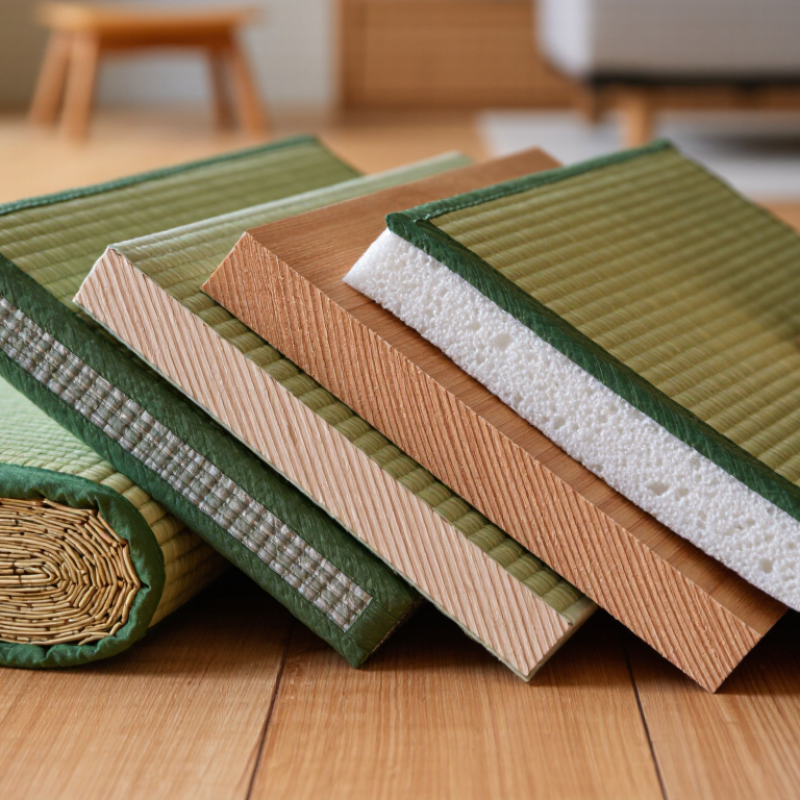
This comparison shows representative layer allocations for 40 mm tatami mats. Traditional straw-core mats generally use a thicker compressed straw layer, while board-core and hybrid constructions provide more consistent thickness and dimensional stability. Natural rush offers a traditional appearance, whereas paper rush and synthetic woven surfaces are commonly selected for easier maintenance and improved moisture tolerance. Actual specifications may vary by supplier, density, compression, and finishing method.

How to Compare Safety, Comfort, Durability, and Maintenance

A 4 cm tatami mat can feel supportive, but thickness alone does not guarantee safety or comfort. Global buyers should compare the core material, surface weave, edge binding, and tested slip resistance. A dense straw-based core may feel firmer, while foam or composite cores often provide softer cushioning. Check product test reports for emissions, moisture resistance, and structural stability. Requirements can differ by market, so supplier documentation matters.

Comfort depends on how the mat responds under pressure. Stand on it for several minutes, if possible, and notice heel support and surface firmness. A tightly woven finish usually resists daily wear better. However, natural fibers may absorb humidity and develop odors without ventilation. Synthetic surfaces are often easier to clean, but they can feel less breathable. This trade-off deserves honest consideration. Thicker is not always better.

Tips: Ask for core density, surface material, edge construction, and warranty terms. Press the mat at its center and corners. Uneven recovery may signal weak support. Measure room humidity before ordering. Keep mats flat, lift them regularly, and wipe spills quickly with a barely damp cloth. Avoid soaking, harsh chemicals, and prolonged direct sunlight. A washable cover can reduce stains, yet it may trap moisture underneath. Check the underside every few weeks. Small maintenance habits often protect comfort and service life better than marketing claims.

Global Buying Factors: Sizes, Certifications, Shipping, and Cost

For global buyers, a 4cm tatami mat should be selected by structure, size, and use. Traditional rush surfaces feel cooler and textured, while woven synthetic covers resist stains better. Common formats include 820×820mm squares and 910×1820mm rectangles. Confirm finished dimensions, because a few millimeters can affect room layout. Ask for density, edge binding, compression recovery, and moisture resistance data. A sample is essential. Photos hide uneven corners.

Certification needs destination-specific checking. Request test reports for formaldehyde, VOC emissions, heavy metals, and mold resistance. OEKO-TEX Standard 100 can support textile safety claims, but it does not certify the entire mat. For European sales, ask suppliers to address applicable REACH substance requirements. For children’s products in the United States, additional safety testing may apply. Do not accept “eco-friendly” as evidence. It is too vague.

Shipping cost depends heavily on volume. A 4cm mat uses more container space than buyers often expect, even when each unit feels light. UNCTAD’s Review of Maritime Transport 2024 reported that maritime trade grew 2.4% in 2023, while disruptions continued to affect routes and rates. Compare EXW, FOB, and delivered quotations using identical carton sizes. The World Bank’s Logistics Performance Index 2023 also shows meaningful differences in customs and delivery reliability between countries. Request pallet photos, moisture barriers, carton drop tests, and a landed-cost estimate. My practical concern is simple: the cheapest quote may become expensive after damage, storage, or rework.

Optimized by Optimole